Worth remembering
- A private scenic seaplane flight on the east coast, listed as 15 to 30 minutes in the air, with starting times shown when you check availability.[1]
- Seaplane passengers must be at least 15 years old and weigh no more than 100 kilograms.[2]
- The listed stop is Belle Mare, the beach where the One&Only Le Saint Géran resort is set.[1][3]
- Reserve now and pay later, with free cancellation up to 24 hours in advance for a full refund.[1]
- From US$254, rated 4.22 from 128 reviews, with 4.3 for guide and 4.4 for value for money.[1]
- Top choice East Coast Seaplane Tour from US$254 Duration15 to 30 minutes[1]Rated4.22 from 128 reviews[1]LanguagesDriver: English, French[1]Pay laterReserve now & pay later[1] Check availability
- South East Lagoon Speedboat from US$144 Duration7 hours[4]Rated4.77 from 452 reviews[4]LanguagesLive tour guide: English, French[4]Pay laterReserve now & pay later[4] See this tour
- Northern Isles Catamaran from US$81 Duration8 hours[5]Rated4.70 from 2,082 reviews[5]LanguagesDriver: English, French[5]Pay laterReserve now & pay later[5] See this tour
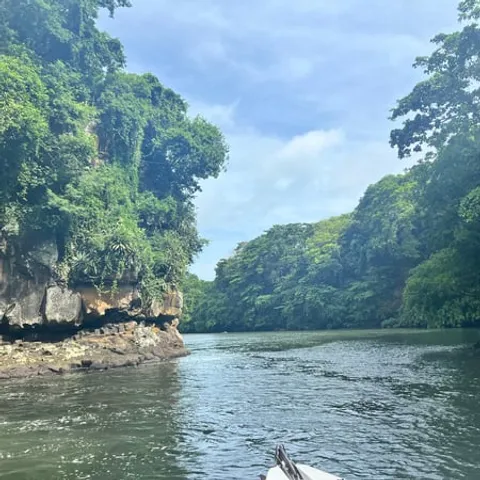
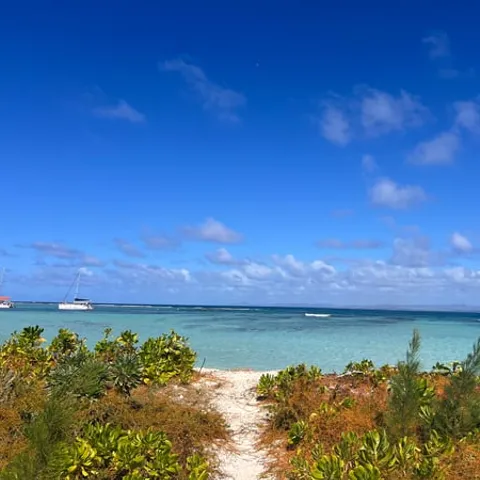
The cyclonic season officially starts on 15 November and ends on 15 May.
Is the seaplane flight worth a morning?
Things to check
On the day
- Plan for 15 to 30 minutes in the air, plus time on the water before and after[1]
- Early flights usually meet the calmest air and the softest light over the lagoon
- Listen to the pilot's briefing and keep loose items stowed for the flight
- Take a light layer: it is breezier and cooler once you climb
Before you arrive: planning the morning
A seaplane day starts well before the engine does, and the first thing to accept is that flying off water means flying with the weather. Wind across the lagoon, cloud sitting on the hills inland, swell breaking along the reef: the pilot reads all of it on the morning itself, and the plan bends around what the water is doing. The practical response is simple. Keep the morning loose, avoid promising anyone a tight lunch booking, and check your messages before you leave the hotel. The flight is listed as 15 to 30 minutes in the air, with starting times shown when you check availability, so the hours around it deserve as much thought as the flight itself.[1]
Two numbers decide who flies. Seaplane passengers in Mauritius must be at least 15 years old and weigh no more than 100 kilograms.[2] If that rules out part of your group, the flight still works as something to watch from the shore: the east coast beaches are pleasant places to wait, and the aircraft tends to come back to the same stretch of water it left. A Mauritius seaplane experience is short by design, so dress for a small cockpit rather than a hike. Flat shoes that slip off easily, a light layer for the breeze once you climb, and nothing loose rolling around your feet.
At the base: checks, weighing and the briefing
Seaplane bases are small places, and that is part of the appeal. You arrive, somebody greets you, and within a few minutes your booking is confirmed and the weather has been discussed. This is not an airport queue. There is no terminal to walk, no gate to find, no belt to wait at. Weight matters more than it does on an airliner and the load is worked out carefully, so scales are usually part of the process, and they take seconds.
The briefing is short and worth listening to. Someone will point out the door, show you how the headsets work so you can talk to the pilot over the engine, and explain what to do with your hands, your phone and your camera strap. The driver languages listed for this tour are English and French, and the listing is for a private group.[1] It is a quieter start than a shared departure anywhere else. If you have questions about the route or the coastline below, ask them here rather than over the water.
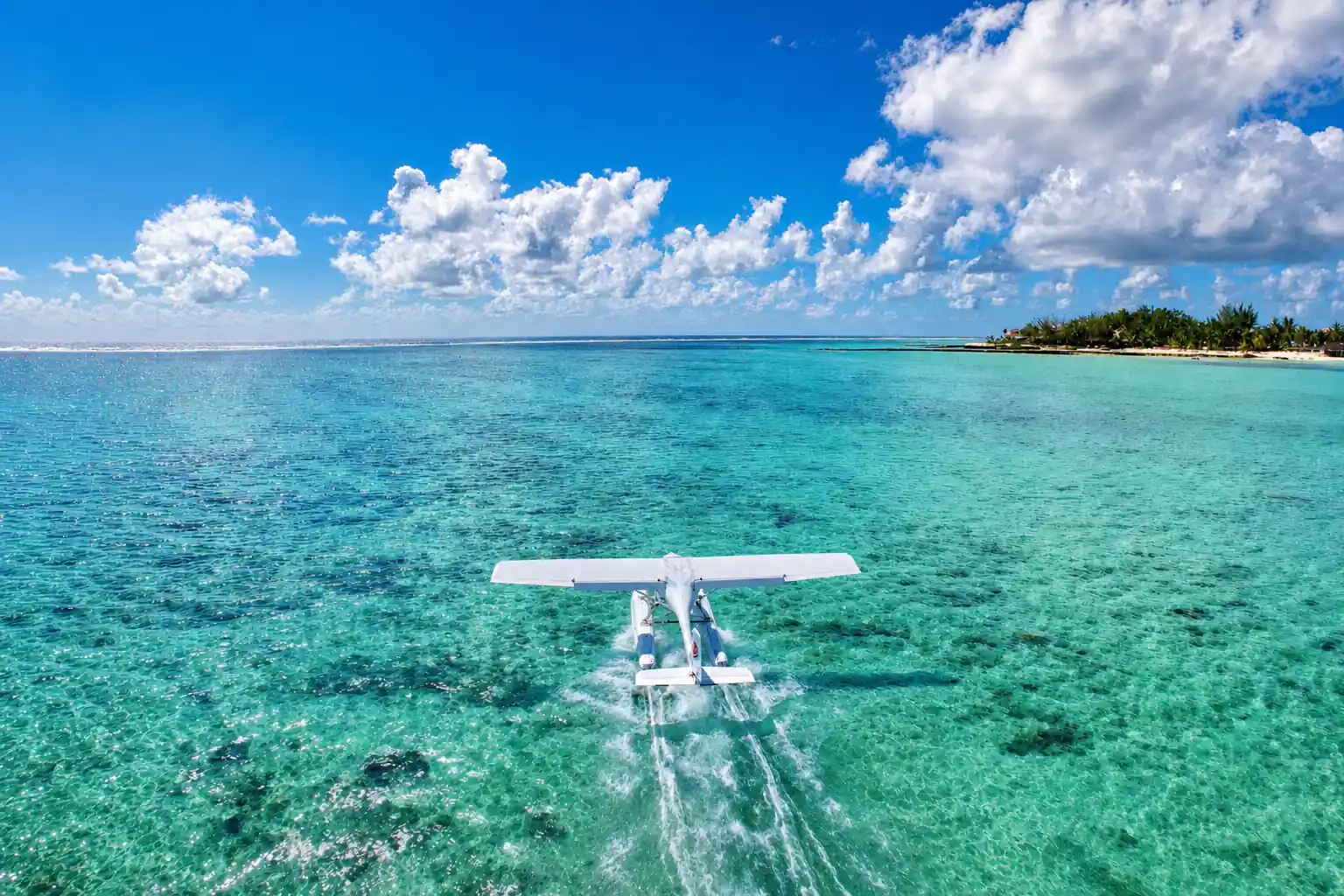
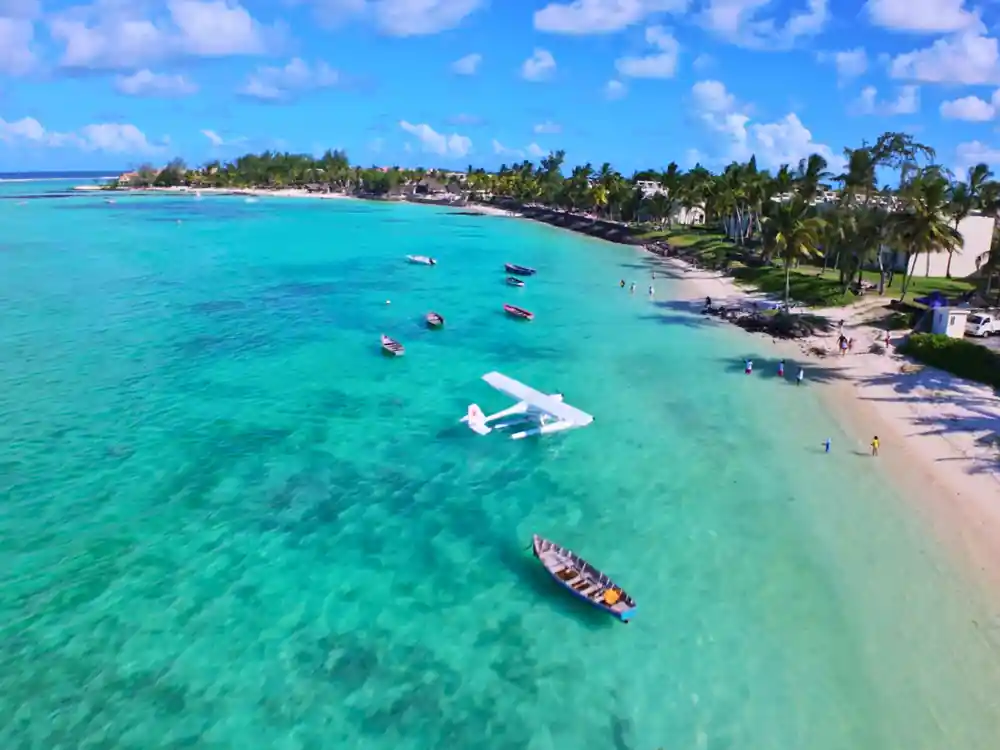
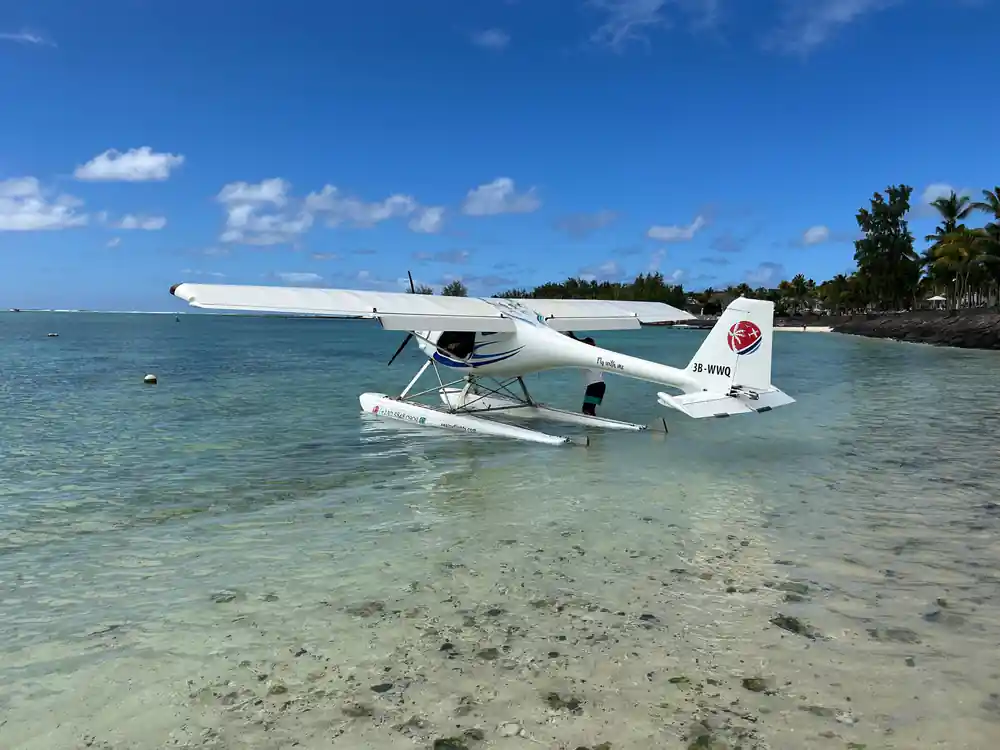
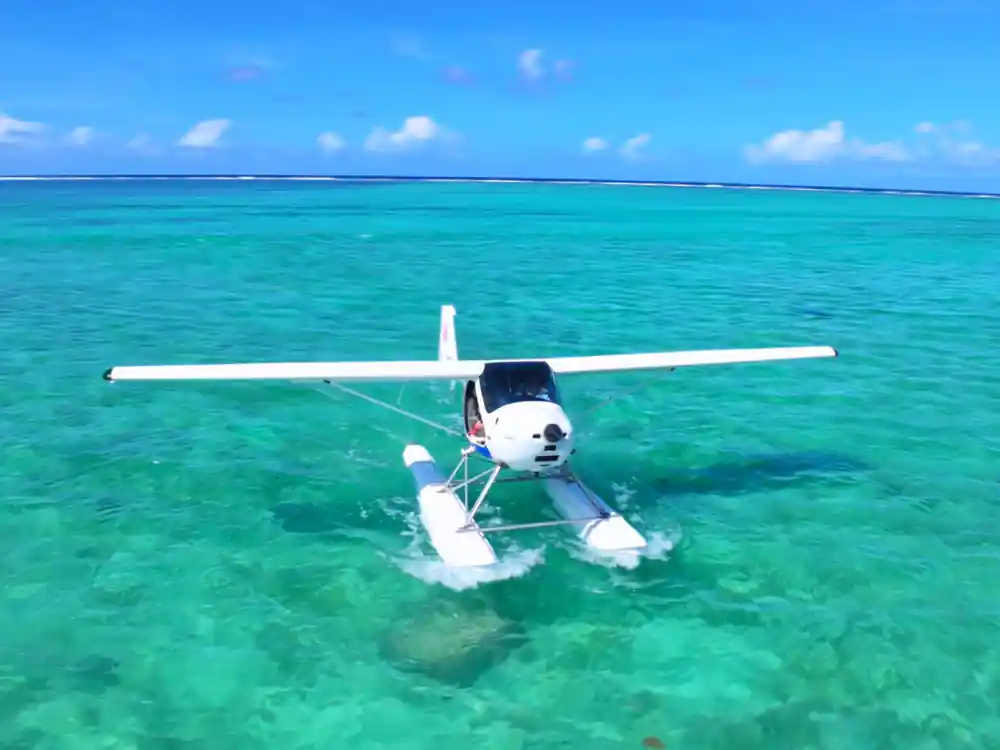
The floats skim bright turquoise water as the seaplane lines up for its run.
Walking out and getting in
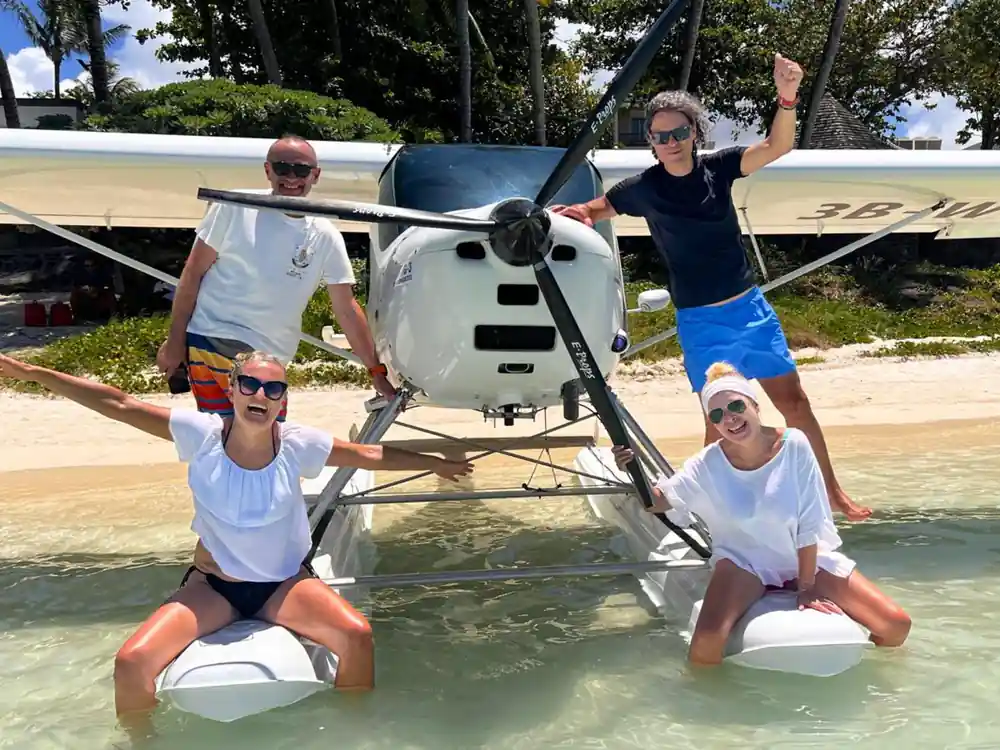
There is a moment on a seaplane day that people remember before the flight has even begun: the walk to the water. You leave the base, cross sand or a pontoon, and the aircraft sits there on its floats, rocking gently, smaller up close than it looked from a distance. You board one at a time with the pilot or ground crew guiding every step, and the handholds are where they point, not where you guess. Flat shoes are easier than strappy sandals, and a small bag is easier to leave behind than a large one.
Getting in is a step up and across rather than a climb, and it is not the moment to be carrying a coffee or a beach bag. Sit where you are asked to sit, with the load already worked out, and let the crew close the door. Then you are strapped in with a headset over your ears, and the water is right there under the floats, close enough to watch through the window while you wait for the engine.
The take-off: a runway made of water
Take-off is the part most people do not expect. There is no runway, no tower and no long wait at a threshold. The pilot starts the engine, runs through the checks, and the aircraft taxis across the lagoon, turning into wind. This is the heart of the seaplane experience Mauritius is known for: the note of the engine rises, the floats lift onto the plane of the water, and the machine accelerates over a surface that looks far too soft to be a runway. Then the bumps stop, the horizon drops away, and you are climbing.
On a calm morning the run is short and the climb is gentle, with the lagoon sliding past underneath. On a breezier day the water is choppier, the run is longer, and the opening climb feels livelier. Either way the change from boat to aircraft happens quickly, somewhere out in the middle of the lagoon, and there is a particular hush when the engine note settles and the water is suddenly far below you.
from US$254
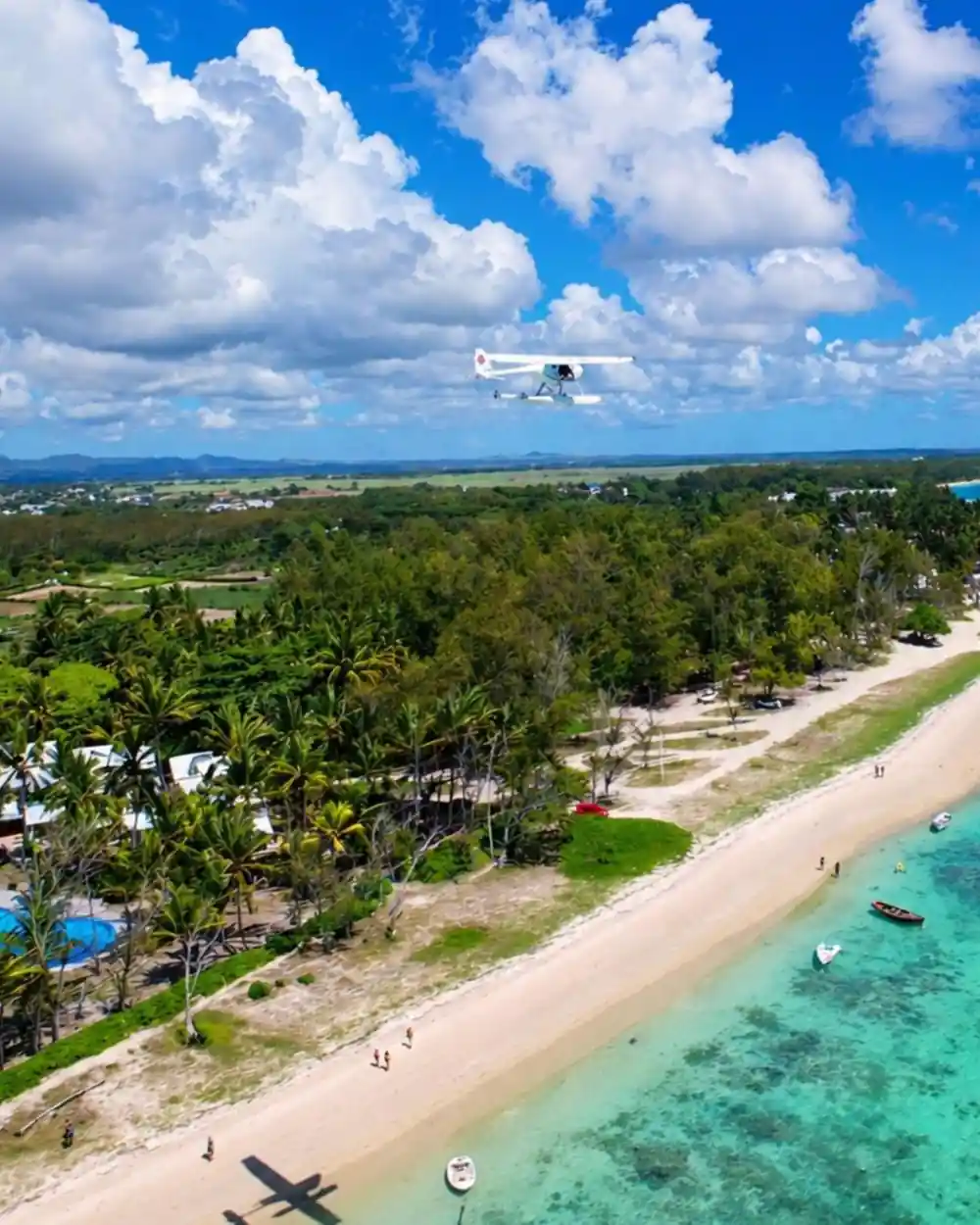
A private scenic seaplane flight on the east coast, listed as 15 to 30 minutes in the air with a stop at Belle Mare.[1]
In the air: reef, lagoon and the east coast
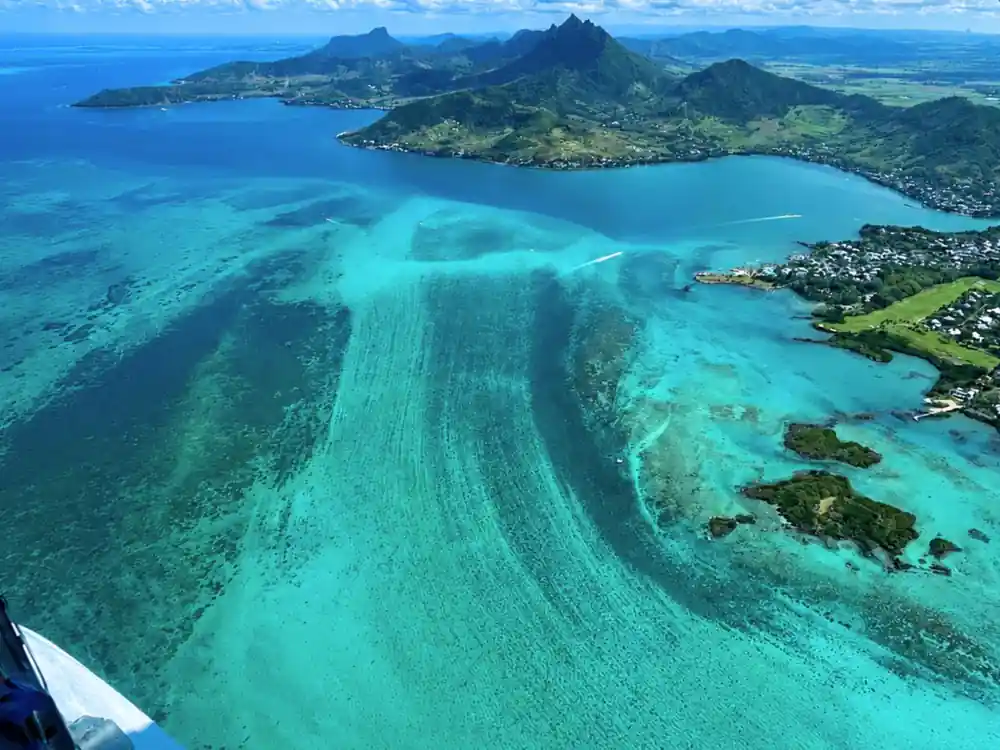
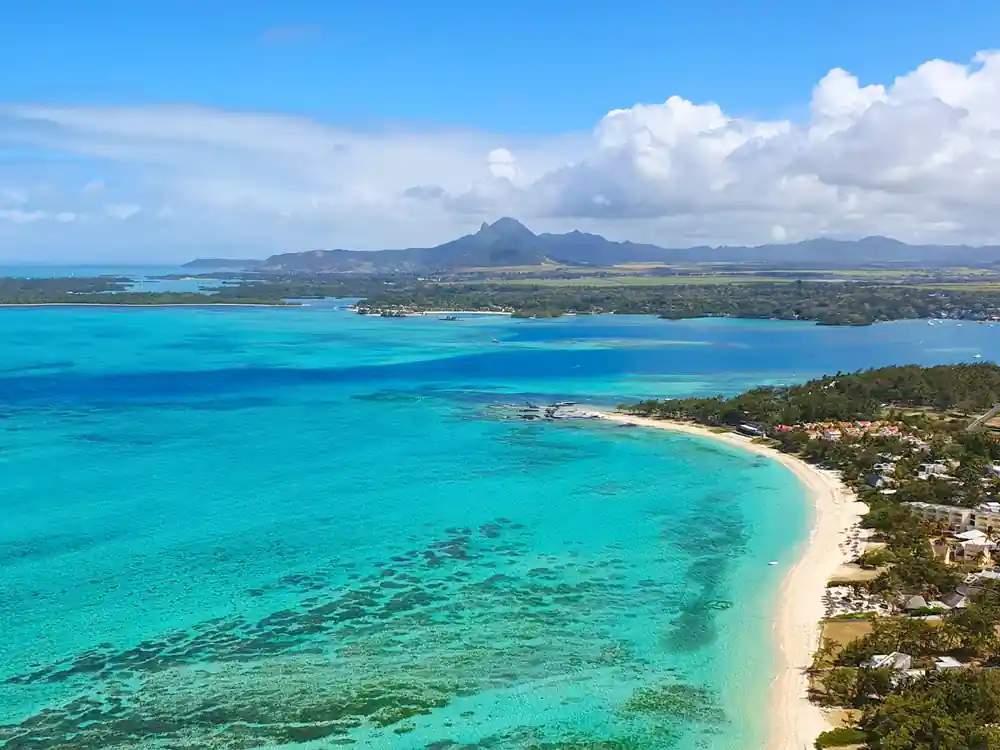
Once you are up, the island rearranges itself into bands of colour. Deep blue where the channel drops away, bright turquoise over the shallow lagoon, a white line of foam along the reef, and pale sand inside it. From a seaplane the water is the main event. You can read the texture of the lagoon floor, the darker patches of coral and seagrass, the channels where the current moves, and the shadows of clouds drifting across all of it.
This route lists Belle Mare as its stop, the beach where the One&Only Le Saint Géran resort is set.[1][3] Further along the same coast, Ile aux Cerfs covers 87 hectares and is known for white sandy beaches, turquoise lagoons, restaurants, water sports and land activities.[6] Inland, the Grande-Rivière-Sud-Est waterfall sits at the source of the river and can be reached by sea or by crossing the sugarcane fields.[7]
Mauritius has a second, very different sight from the air: the underwater waterfall illusion lies to the southwest, offshore of Le Morne Peninsula.[8] An east coast flight has its own landmarks, among them Lion Mountain, whose striking silhouette resembles a lion lying down and which is the only witness left of the Battle of Grand Port.[9] Where the pilot takes you on the day depends on the wind, the light and the movement on the water below.
Landing and afterwards
The landing is the take-off in reverse and usually gentler than people expect. The floats touch the water in a long soft skim, the engine note drops, and the aircraft becomes a boat again, taxiing back to the spot where you started. There is often a quiet minute while the door opens and the everyday sounds of the beach return: wind, waves, and somebody's radio further along the sand.
Back on land, the booking details are the ones worth keeping in mind. The listing allows free cancellation up to 24 hours in advance for a full refund, and you can reserve now and pay later.[1] It is rated 4.22 from 128 reviews, with 4.3 for guide and 4.4 for value for money.[1] Once you are back on the sand, the rest of the day is yours, and the east coast is generous with it.
Fitting the flight into an east coast day
A Mauritius seaplane trip is often the shortest outing of an entire holiday, which makes it easy to slot into a bigger day. Fly in the morning, then give the afternoon to the lagoon: a long swim, a beach lunch, a walk along the sand at Belle Mare while the light turns gold. If you have a car, the coastal road between the seaplane base, Belle Mare and Trou d'Eau Douce is an easy drive with plenty of places to stop for a cold drink.
One of the more unusual east coast Mauritius activities is also one of the shortest, so it leaves room for the rest of the island. A full-day catamaran cruise to the northern isles starts from US$81.[5] A full-day speedboat tour to Ile aux Cerfs and the Grand River South East waterfall starts from US$144.[4] If you would rather stay in the air, a scenic helicopter flight with hotel transfers starts from US$860, and Mauritius helicopter tours include a fifteen-minute ride that starts at roughly 8,500 MUR per person.[10][11]
Book the flight for the morning if you can, and treat a change of plan as normal rather than a disappointment. Water flying is flexible by nature: the same lagoon that gives you a smooth take-off can turn breezy an hour later. What people take away from a Mauritius seaplane experience is rarely the itinerary. It is the odd, lovely moment when the water lets go, the noise of the island fades, and the coast turns into a map below you.
Reviews behind each tour listing
From-prices in US dollars
From-prices in US dollars from the listings:[1][4][5]
When to fly and when to book
On the day, step by step
Before you arrive
Check the weather, eat something light and leave slack in the morning.
At the base
Someone confirms your details and walks you through the flight over the water.
Walking out
You cross the sand or pontoon to the aircraft and step in one at a time.
The take-off
The engine note rises, the floats lift and the lagoon becomes a runway.
In the air
Reef, lagoon and beach unfold below, with Belle Mare listed as the stop.[1]
Landing
The floats touch back on the water and the rest of the day is yours.
Ready to see the east coast lagoon from above?
from US$254Reserve now & pay later